Exposure
Wilfred Owen's 'Exposure' is a devastating critique of the reality of trench warfare, stripping away the myth of heroic battle to reveal the agonizing truth of soldiers dying from the cold. Studying this poem is rewarding because it offers profound insights into the psychological toll of conflict and the indifference of nature, making it a powerful piece for deep literary analysis.
Study Notes
Overview
'Exposure' by Wilfred Owen is a seminal piece of World War I poetry that masterfully captures the grim reality of life in the trenches. Unlike traditional war poetry that glorifies combat, Owen focuses on the prolonged, agonizing anticipation of death and the brutal physical suffering caused by the extreme cold. Examiners look for candidates who can analyze how Owen uses sensory imagery, personification, and a repetitive structure to convey the futility of war and the sense that nature itself is a hostile, indifferent force. Strong responses will integrate Owen's personal context as a soldier on the Western Front to enrich their interpretation.
Plot/Content Overview
The poem does not follow a traditional narrative arc but rather presents a cyclical experience of suffering:
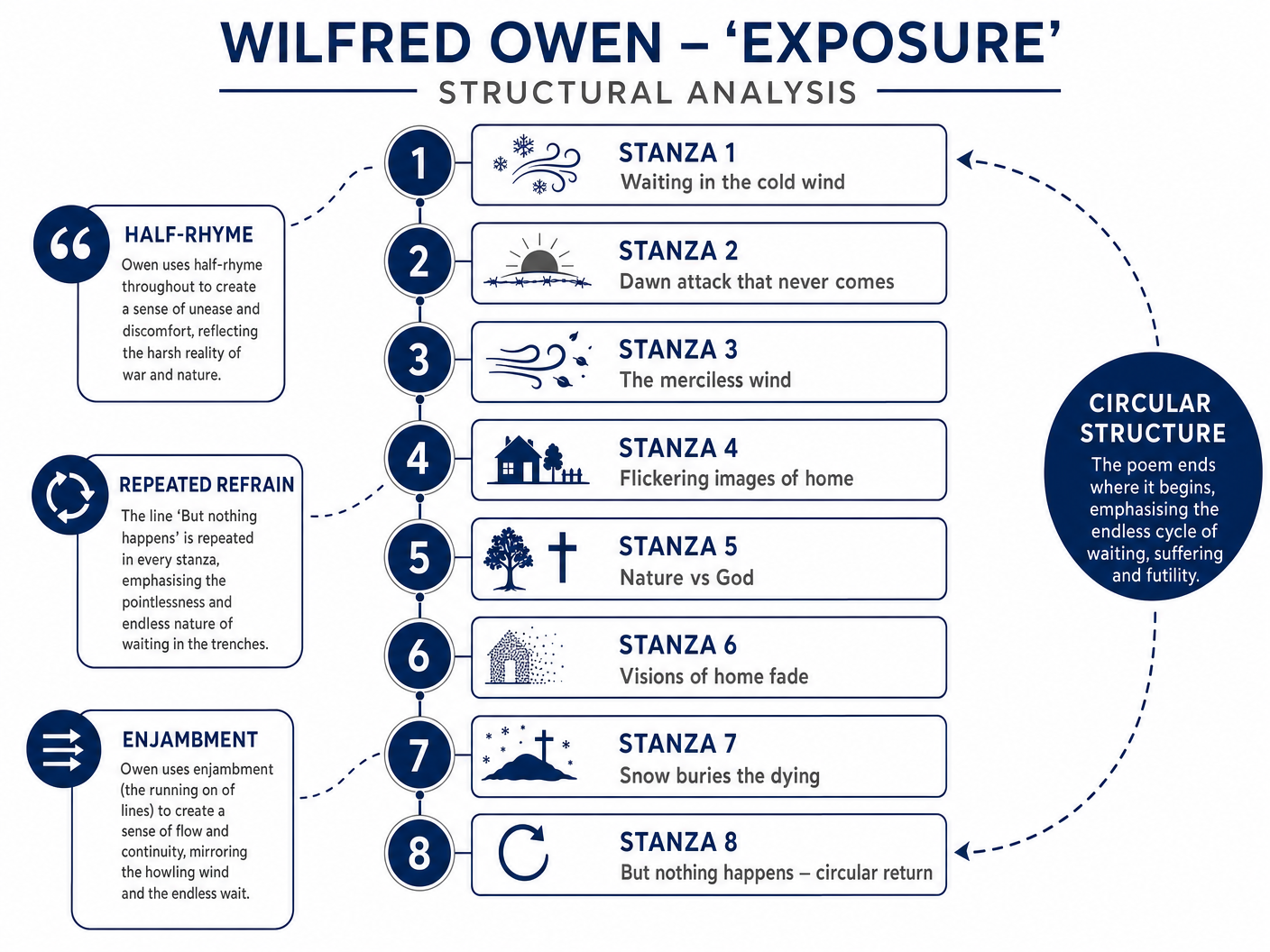
- Stanza 1-3: The soldiers wait in the freezing trenches at night, battered by the wind and anticipating an attack that never comes.
- Stanza 4-6: The men begin to hallucinate or dream of home, warm fires, and spring, but these visions fade as they realize they are cut off from that world.
- Stanza 7-8: The harsh reality of the snow and cold returns. The soldiers accept their impending deaths, and the poem ends exactly as it began, with the bleak realization that 'nothing happens.'
Themes
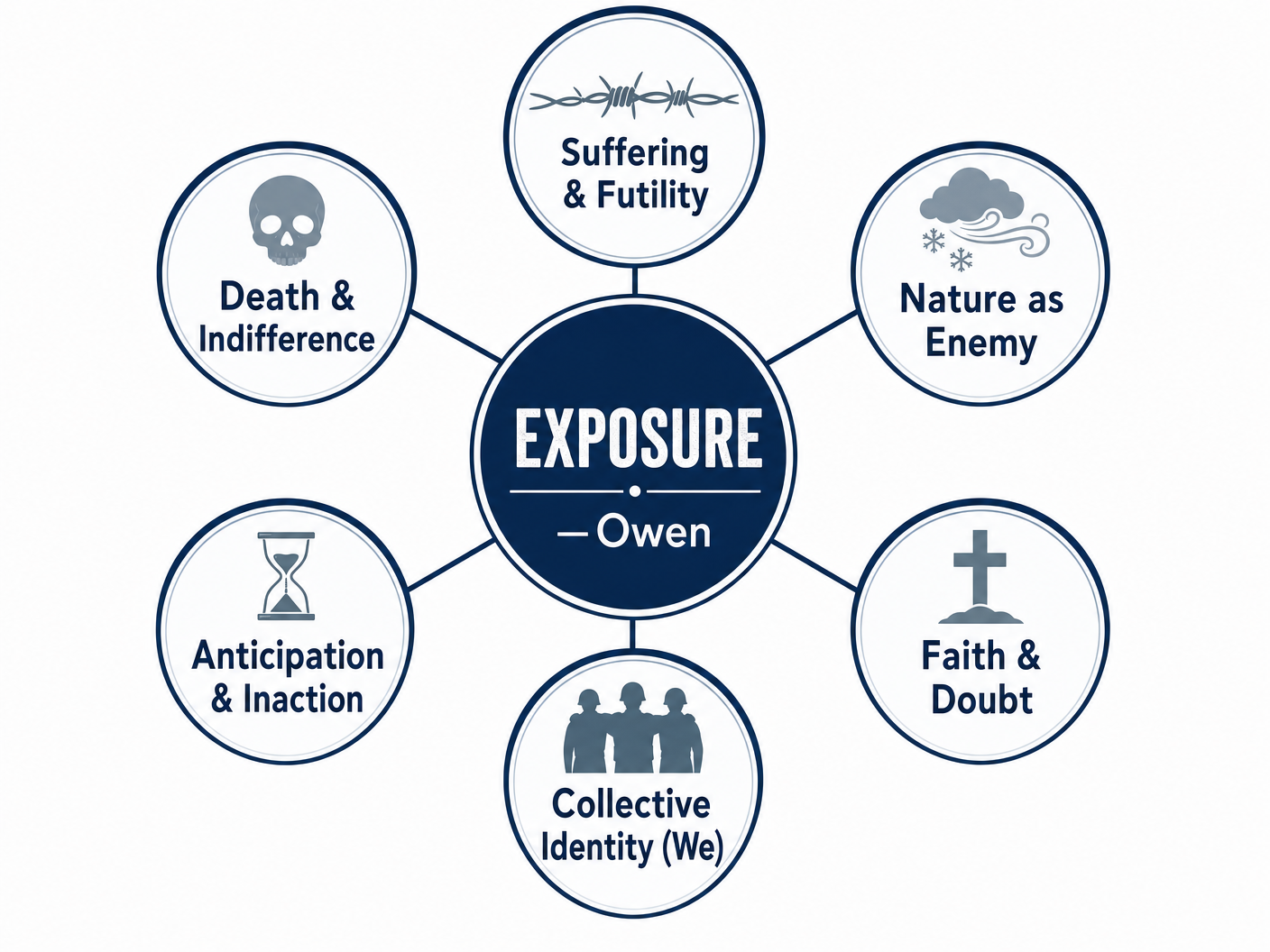
Theme 1: Suffering and Futility
Owen presents suffering not as the result of glorious combat, but as a slow, agonizing process caused by exposure to the elements. The futility of their situation is emphasized by the lack of action.
Key Quotes:
- "Our brains ache, in the merciless iced east winds that knive us..." (Stanza 1) - The physical pain is immediate and intense. The use of 'knive' as a verb highlights the aggressive nature of the cold.
- "But nothing happens." (Repeated refrain) - This anti-climactic phrase underscores the pointless waiting and the lack of resolution or heroic action.
Theme 2: Nature as an Antagonist
In 'Exposure', nature is not a passive backdrop but an active, hostile force that is more deadly than the enemy soldiers.
Key Quotes:
- "Dawn massing in the east her melancholy army" (Stanza 3) - Dawn, usually a symbol of hope and new beginnings, is personified as a military force bringing more suffering.
- "Pale flakes with fingering stealth come feeling for our faces" (Stanza 4) - The snow is personified as a sinister, deliberate killer, emphasizing the maliciousness of the natural world.
Theme 3: Faith and Doubt
The extreme suffering leads the soldiers to question their faith and the existence of a benevolent God.
Key Quotes:
- "For love of God seems dying." (Stanza 6) - This ambiguous line suggests either that the men's faith in God is fading, or that God's love for them has ceased to exist in this hellish environment.
Writer's Methods
Owen employs several sophisticated methods to convey his message:
- Personification: By personifying the weather (e.g., 'mad gusts tugging on the wire'), Owen makes nature the primary enemy.
- Sibilance: Phrases like 'Sudden successive flights of bullets streak the silence' use sibilance to mimic the hissing sound of bullets and the biting wind, creating a harsh, uncomfortable auditory experience.
- Structure and Form: The poem uses a modified sonnet-like structure with eight stanzas. The consistent use of half-rhyme (e.g., 'knive us' / 'nervous') creates a sense of unease and dissonance, reflecting the unnatural state of the soldiers' existence. The repetition of 'But nothing happens' creates a cyclical structure, emphasizing the endless, inescapable nature of their suffering.
Context
Wilfred Owen wrote 'Exposure' in the winter of 1917 while recovering from shell shock (PTSD) at Craiglockhart War Hospital. He had experienced the brutal winter on the Western Front, which was one of the coldest on record. Owen's purpose was to expose the 'pity of war' to the British public, countering the jingoistic propaganda of poets like Jessie Pope. Examiners expect candidates to use this context not as a bolt-on historical fact, but to explain why Owen's imagery is so starkly realistic and anti-heroic.
Interactive Diagrams
1 interactive diagram to visualise key concepts
Conceptual Flow Outline
The cyclical structure of suffering in 'Exposure'
Worked Examples
2 detailed examples with solutions and examiner commentary
Practice Questions
Test your understanding — click to reveal model answers
How does Owen present the effects of conflict in 'Exposure'?
Hint: Consider both the physical effects (cold, death) and the psychological effects (despair, loss of faith).
Compare how poets present the power of nature in 'Exposure' and 'Storm on the Island'.
Hint: Both poems present nature as an aggressive force, but consider the different contexts (war vs. rural life) and outcomes.
Explore the significance of the title 'Exposure' in the context of the whole poem.
Hint: Think about the multiple meanings of the word 'exposure' (physical vulnerability, revealing the truth).
How does Owen use structure and form to convey the soldiers' experience in 'Exposure'?
Hint: Focus heavily on AO2. Discuss half-rhyme, the repeated refrain, and the cyclical nature of the stanzas.